HomeReady Refinance
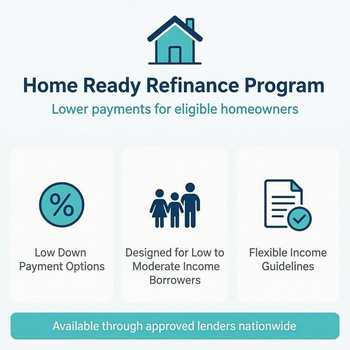 If you own a home and your household income is moderate, a Fannie Mae HomeReady refinance can help you lower your monthly payment or reduce your interest rate. This conventional loan program is specifically designed for borrowers with income at or below 80% of the area median income (AMI) for their location. Unlike classic refinance programs, HomeReady offers reduced mortgage insurance premiums, flexible income documentation, and the ability to include non-borrower household income. This guide explains how to qualify, what you save, and whether a HomeReady refinance is right for your situation.
What Is a HomeReady Refinance?
A HomeReady refinance is a limited cash-out refinance for borrowers with moderate income who want to replace their existing mortgage with a new one that has better terms. Unlike a cash-out refinance, you cannot pull money from your equity. The goal is to lower your monthly payment, reduce your interest rate, or change your loan term. This program is backed by Fannie Mae, the government-sponsored enterprise that purchases and securitizes mortgages nationwide.
HomeReady refinances offer two major advantages. First, mortgage insurance premiums are lower than standard conventional loans - often 25 to 50 percent less. Second, the program allows you to count non-borrower household income to meet the AMI limit, even though that income does not qualify you under debt-to-income rules. For example, if a parent or adult child lives with you, their income can help you stay under the 80% AMI threshold.
Key Eligibility Requirements
Before you contact a lender, confirm you meet these core HomeReady requirements.
- Minimum Credit Score: You need a credit score of at least 620. A higher score helps you avoid loan-level price adjustments and qualify for better rates.
- Income Limit: Your total annual household income cannot exceed 80% of the area median income (AMI) for your county. Use Fannie Mae's official AMI lookup tool to verify your eligibility.
- Debt-to-Income Ratio: Your total monthly debt should not exceed 45% to 50% of your gross monthly income. This includes the new mortgage payment, property taxes, insurance, and all other debts.
- Existing Fannie Mae Mortgage: For a limited cash-out HomeReady refinance, your current mortgage must be owned or securitized by Fannie Mae. Your lender will verify this through Fannie Mae's database or loan lookup tool.
- Primary Residence Only: The property must be your primary residence. Eligible property types include single-family homes, condos, PUDs, co-ops, manufactured homes, and 2- to 4-unit owner-occupied properties.
- Conforming Loan Limits: Your new loan amount must fall within conforming limits for your county. For 2025, the limit for a single-family home is $806,500 in most areas.
- Maximum LTV: The loan-to-value ratio cannot exceed 97% for a limited cash-out refinance. If your new balance plus closing costs exceeds 97% of your home's current value, you must pay the difference at closing.
Understanding the 80% Area Median Income Limit
The income limit is HomeReady's most important requirement. You must verify that your household income does not exceed 80% of the AMI for your property location. This is not a poverty test - many working families with solid incomes qualify.
For example, if the area median income in your county is $100,000, you can earn up to $80,000 per year and still qualify. All borrowers on the note count toward this limit. However, non-borrower household members - such as adult children or parents - can add their income to meet the limit without appearing on the mortgage. This feature is powerful for multigenerational households.
Use the official Fannie Mae AMI lookup tool to find the exact limit for your property. Your lender will verify your income eligibility during the application process.
Financial Benefits: Lower Mortgage Insurance and Reduced Costs
HomeReady refinances deliver real savings through reduced mortgage insurance premiums. If your new loan balance exceeds 80% of the home's value, you will pay mortgage insurance. However, HomeReady's premiums are significantly lower - often 25 to 50 percent below standard conventional rates.
For loans with LTV above 90%, the coverage is only 25 percent, which keeps your monthly payment lower. You can request cancellation of mortgage insurance once your LTV reaches 80%, provided you have made timely payments and maintained the property.
Additional savings come from the ability to roll closing costs into the new loan. As a limited cash-out refinance, you can include discount points, prepaid taxes and insurance, and origination fees in your new balance - up to the 97% LTV limit. This avoids out-of-pocket costs at closing.
Sample Financial Comparison
| Feature | Standard Conventional Loan | HomeReady Refinance |
|---|---|---|
| Minimum Credit Score | Usually 660+ | 620 |
| Income Documentation | W-2s, pay stubs, tax returns only | Flexible; allows non-traditional sources and non-borrower household income |
| Mortgage Insurance Cost (at 90% LTV) | Standard PMI rates (typically 0.55–1.0%) | Reduced premiums (typically 0.25–0.50%) |
| Max LTV for Refinance | Varies; often 95% for rate/term | Up to 97% for limited cash-out |
| Closing Costs | Paid out-of-pocket or rolled in (increases balance) | Can roll in up to 97% LTV |
| Income Limit | No limit; all incomes accepted | 80% of area median income |
| LLPA Waiver | No waiver; standard pricing adjustments apply | Most LLPAs waived; lower pricing overall |
Step-by-Step: How to Apply for a HomeReady Refinance
- Check Your Income Eligibility: Use Fannie Mae's AMI lookup tool to confirm your household income is at or below 80% of the AMI for your property location.
- Verify Current Mortgage Ownership: Call your mortgage servicer or log into your account to confirm that Fannie Mae owns or backs your current loan. You can also use the Fannie Mae loan lookup tool.
- Find a Participating Lender: Not all lenders offer HomeReady products. Contact banks, credit unions, or mortgage brokers and ask specifically whether they participate in the Fannie Mae HomeReady program.
- Gather Documentation: Prepare recent pay stubs (typically 2–4 weeks), two years of tax returns, current bank statements, and information about your existing mortgage (statement, note details, servicer contact).
- Submit Application: Complete the mortgage application and provide all required documents. Your lender will order an appraisal and verify your income against the 80% AMI limit.
- Underwriting and Conditional Approval: The lender's underwriter will review your application, appraisal, and financial documents. You may receive a conditional approval requiring additional items.
- Final Approval and Clear to Close: Once all conditions are satisfied, you receive final approval. Your lender schedules an appointment date.
- Closing: Sign loan documents at closing. If your new balance plus costs exceeds 97% LTV, bring funds to cover the difference. Otherwise, you may receive a credit if applicable.
Loan-Level Price Adjustments (LLPAs) and Credits
Fannie Mae applies loan-level price adjustments (LLPAs) based on credit score, LTV, and other risk factors. These adjustments increase your interest rate or fees. However, HomeReady borrowers benefit from LLPA waivers and reductions. Most LLPAs are waived for HomeReady loans except those related to mortgage insurance coverage minimum thresholds.
If you complete housing counseling through an approved provider, you may qualify for additional price adjustment credits at closing. These credits further reduce your costs. Always ask your lender about available credits before closing.
Common Scenarios and Program Variations
Refinancing from an FHA Loan
If you currently have an FHA mortgage, you can refinance to a HomeReady conventional loan. This move typically lowers your mortgage insurance costs because FHA mortgage insurance premiums (MIP) are generally higher than HomeReady's reduced insurance premiums. You must still meet the 80% AMI income limit and have a credit score of 620 or higher.
Multifamily Properties (2–4 Units)
If you own a 2- to 4-unit property and occupy one unit as your primary residence, HomeReady refinance is available. You can count the projected rental income from the other units as household income to help meet the debt-to-income and income limit requirements. This is especially valuable if your personal W-2 income is modest but the property generates strong cash flow.
Including Non-Borrower Household Income
You can include the income of household members who do not sign the mortgage note. Common scenarios include adult children, parents, or other family members living in the home. This income counts toward the 80% AMI limit but does not improve your debt-to-income ratio for qualification purposes. The person earning the income does not need to be on title or the note - only living in the home.
Frequently Asked Questions
What if my current loan is not owned by Fannie Mae?
If your existing mortgage is backed by Freddie Mac, a bank, or another owner, you may still be able to refinance, but it would be a cash-out refinance subject to standard conventional guidelines rather than the limited cash-out HomeReady program. Cash-out refinances have stricter LTV limits, higher mortgage insurance premiums, and fewer income flexibility options. Confirm your loan's owner before applying.
Can I refinance if I am behind on payments or have late payments?
HomeReady refinances require a clean payment history on your existing mortgage. Typically, you must have no 30-day late payments in the past 12 months and no 60-day lates in the past 24 months. The program is designed for borrowers who want to improve their situation, not rescue distressed borrowers.
What happens if the appraisal comes in lower than expected?
If your home appraises for less than you owe, your LTV increases. This may push you over the 97% limit. If that happens, you have two options: bring funds to closing to reduce the loan balance below 97% LTV, or work with your lender to find alternative refinance programs. A lower appraisal can also affect whether you can roll closing costs into the loan.
Can I get a cash-out HomeReady refinance?
No. HomeReady is a limited cash-out program only. You cannot withdraw equity. Any new loan proceeds must be used to pay off your existing mortgage. You can roll closing costs, discount points, and prepaid items into the new loan, but you cannot take cash out for other purposes.
What if I own a second property?
Fannie Mae allows you to own one additional financed property while refinancing your primary residence with HomeReady. The second property can be a rental, vacation home, or investment. However, the mortgage payment on the second property counts toward your debt-to-income ratio for qualification.
How long does a HomeReady refinance take?
Typical closing timelines are 30 to 45 days from application to funding. Your lender's workload, appraisal turnaround, and how quickly you provide documentation affect the actual timeline. Ask your lender for an estimated closing date when you submit your application.
Are there any prepayment penalties?
HomeReady refinances typically have no prepayment penalty. You can pay off your loan early without cost. Confirm this with your lender before signing closing documents.
Is HomeReady Right for You?
A HomeReady refinance makes sense if you meet these conditions: you have a Fannie Mae-backed mortgage, your household income is at or below 80% AMI, you have a credit score of 620 or higher, you want to lower your rate or payment, and you have maintained your property and made timely payments. The reduced mortgage insurance and flexible income rules deliver real savings throughout the life of the loan.
Contact a HomeReady-participating lender today to explore your options and get a rate quote.
Connect With Us
Please share – it really helps